Notebook
Johannes Brahms — Handel Variations (Op. 24)
A birthday gift for Clara Schumann, in Brahms's own hand. Then pages of your own.
$35.00 USD
Explore the notebook →Métrica
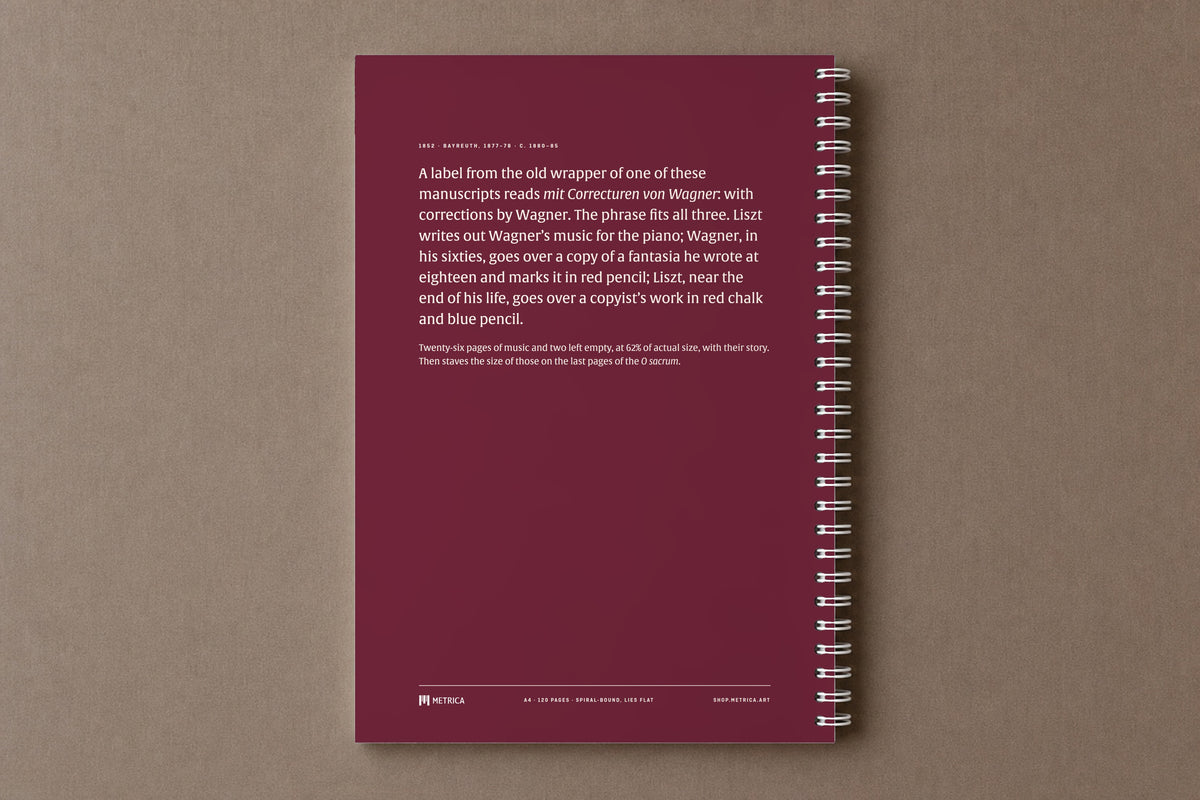
Three manuscripts by Liszt and Wagner, each the work of two musicians. Then pages of your own.
Free US shipping on 2+ pieces. $8 on one.Free US shipping on two or more pieces. $8 flat on a single one.
Printed to order, then shipped with tracking. Shipping policy
Add a second — shipping’s on us.
Couldn't load pickup availability
Three manuscripts by Liszt and Wagner, each the work of two musicians. Then pages of your own.
A label from the old wrapper of one of these manuscripts reads mit Correcturen von Wagner: with corrections by Wagner. The phrase fits all three. In the Lohengrin, dated December 18, 1852, the music is Wagner's and the hand is Liszt's. In the Fantasia in F-sharp minor, which Wagner wrote at eighteen, the hand is Anton Seidl's, who copied it at Bayreuth around 1877–78, and the corrections are Wagner's, made more than forty years after he wrote the piece. In the O sacrum convivium a copyist wrote out the music, and Liszt went over it in red chalk and blue pencil. All three are kept at the Staatsbibliothek zu Berlin, and this notebook reproduces their 28 pages complete.
First, a short guide: the label that gives the notebook its name; Liszt and Wagner, who became father-in-law and son-in-law; Elsa's procession from Lohengrin, which Liszt arranged for the piano and signed off 18 December / Soir = 52., Für Hans.; the Fantasia, and Seidl, who copied it; Wagner's note in the margin, Mordente ausführen!, “play the mordents!”; and the O sacrum, its bars crossed out in red chalk and scored through in blue.
Then the manuscripts, in the order in which they were written: four pages of Liszt's Lohengrin, sixteen of Wagner's Fantasia and the eight of the O sacrum, the last two ruled and never used. The three are on paper of different sizes, and every page is printed at the same scale, 62% of its size, so that they can be compared.
Then the pages are yours: 78 pages of staff paper, with staves like those on the last pages of the O sacrum.
A4, spiral-bound, it lies flat.
The staves on your pages were measured on the library's photographs of the two empty pages that end the O sacrum: each staff 8.2 mm from its top line to its bottom one, one every 18.7 mm.
Franz Liszt · Elsa's bridal procession from Wagner's Lohengrin, arranged for piano, autograph, December 18, 1852 · Richard Wagner · Fantasia in F-sharp minor, WWV 22, copy by Anton Seidl with corrections by Wagner, Bayreuth, about 1877–78 · Franz Liszt · O sacrum convivium for organ or harmonium, copy with Liszt's corrections, about 1880–85 · Staatsbibliothek zu Berlin – Preußischer Kulturbesitz, Mus.ms.autogr. Liszt, F. 14; Wagner, R. 9; Liszt, F. 15
Notebook details
Another manuscript in its composer’s hand, with pages ruled like his.
Notebook
A birthday gift for Clara Schumann, in Brahms's own hand. Then pages of your own.
$35.00 USD
Explore the notebook →
Notebook
Sixteen songs Schubert copied out for Goethe, who never replied. Then pages of your own.
$35.00 USD
Explore the notebook →